
Shifting Landscape of Security Recruitment: Trends, Challenges, and Strategies
By Mike Hurst CPP® CPOI Director of HJA Consult
This article is in part an assessment of where the profession is and its direction of travel, but also some personal thoughts as to where it should be heading, although in recent years, I have tried to use the word ‘should’ less often.
The security industry encompasses both physical and cybersecurity sectors and is undergoing many changes. The evolving threat landscape, new technologies, the extra demand of law enforcement organisations and the relatively small size of our military means that there is a high demand for skilled professionals in the private sector to deliver robust security measures.
As a result, recruitment is becoming increasingly complex, with both employers and candidates facing unique challenges. Candidate need ensure they are prepared for new employment challenges in terms awareness of the security climate, having the right training and certifications etc and employers need to ensure that have they are positioned to attract and retain top talent.
“The Great Resignation”
The security sector is not immune to this phenomenon. Whilst certain roles, for example, frontline security officers and security engineers, necessitate people to be in place physically, many roles have adopted, successfully, a hybrid approach, to enhance work-life balance. There is pressure in some sectors for a full-time return to an office, although whether this is because of operational efficiency or to justify having large, expensive is to be debated.
The Search for Skilled Professionals / Desirable Employment
There is a security skills shortage in the UK. Many people enter the sector as security officers and whilst that are, I think around 440,000 license holder it is estimated that we need around 60,000 more. This role has change dramatically over the years and whilst there are far too many poor employers, that are many, many good ones where people can build a career.
The rapid pace of technological changes also means that for many roles, companies are looking for professionals with specialized skills, such as cloud security, artificial intelligence, and data analytics on top of good business skills, sales, engineering marketing, project management, leadership and may others.
However, the pool of highly qualified candidates is limited, leading to a fierce competition for talent. What can employers do to address shortages and make themselves an employer of choice. Clearly it is not only about money, but
Competitive pay rates (packages) are important alongside
Professional / Personal Development
Education, training, mentorship to upskill employees.
Culture: one that makes people feel welcome and valued and one that promotes diversity of thought.
Flexibility on behalf of an employer can increase the pool of candidates from which you can recruit.
E.g. flexible hours, a compressed work week, remote working.
Challenging and varied work
Collaborating with colleagues; being part of a team.
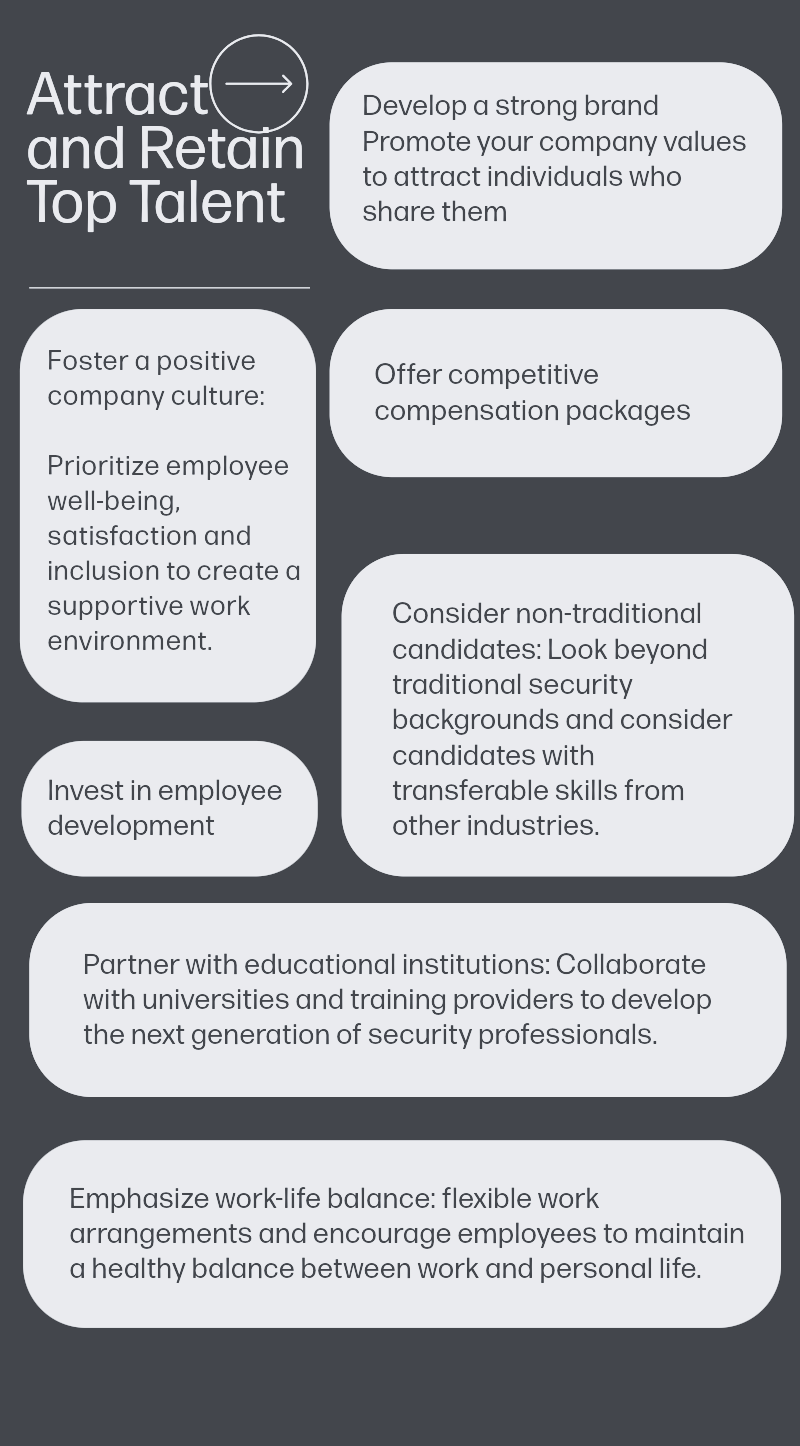
Attracting and Retaining Top Talent
To succeed in the competitive security recruitment landscape, companies must adopt a strategic approach to attracting and retaining top talent. Here are some practical tips:
Develop a strong brand
Promote your company values to attract individuals who share them.
Offer competitive compensation packages
Invest in employee development
Foster a positive company culture:
Prioritise employee well-being, satisfaction and inclusion to create a supportive work environment.
Emphasise work-life balance: Offer flexible work arrangements and encourage employees to maintain a healthy balance between work and personal life.
Partner with educational institutions: Collaborate with universities and training providers to develop the next generation of security professionals.
Consider non-traditional candidates: Look beyond traditional security backgrounds and consider candidates with transferable skills from other industries.
The security industry is facing a complex recruitment landscape, with both employers and candidates trying to stay ahead of changes.
Hopefully some of the items touched on in this article can help develop strategy to 1) recruit the people you need on 2) find that next career move. I do feel, strongly, the key to success lies in developing a strong employer brand and that culture is King/Queen (delete as appropriate). If you can get this right, you can build a skilled, motivated and dedicated team that will drive your organisation forward.
